|
|
|
|
 |
|
Aug 12, 2026
|
|
| |
|
Assam's Rubber economy needs to move up the value chain
|
| |
|
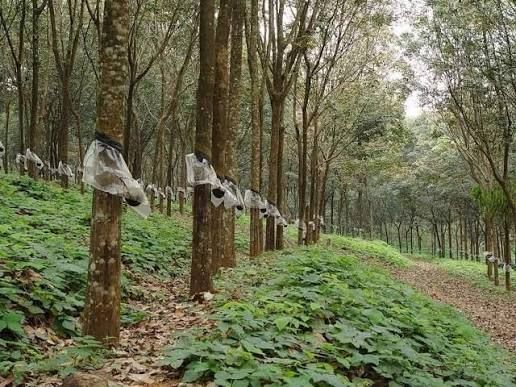
Assam's plantation economy has been identified almost exclusively with tea. That is changing. Natural rubber is emerging as a serious second pillar, and the numbers suggest that it should no longer be treated as a peripheral crop.
In June 2026, the Rubber Board said Assam had become India's third-largest natural rubber producer, after Kerala and Tripura, with nearly 50,000 hectares under rubber. The State's Economic Survey records 94,500 hectares under rubber and production of 47,500 tonnes in 2024-25, with employment estimated at 3.02 lakh people. The difference between these figures reflects statistical definitions, but the direction is unmistakable: rubber is becoming important to Assam's rural economy. This growth has not happened overnight. Assam has promoted rubber on hill slopes for decades, particularly where conventional agriculture is difficult.
The recent acceleration is striking. Assam's rubber area rose from 58,897 hectares in 2020-21 to 94,500 hectares in 2024-25, according to the Economic Survey. Production increased from 34,348 tonnes to 47,500 tonnes, while employment rose from 1.77 lakh to 3.02 lakh. They indicate a plantation economy capable of supporting rural employment and diversifying farm incomes. The wider Indian market makes Assam's expansion strategically important. India produced 8.75 lakh tonnes of natural rubber in 2024-25 but consumed 14.10 lakh tonnes, leaving a gap of 5.51 lakh tonnes met through imports.
In 2023-24, consumption was 14.16 lakh tonnes against production of 8.57 lakh tonnes.
|
|
|
|
|
| |
|
|
|
 |
|
|
|
© Copyright 2026.
All India Rubber Industries Association. All rights reserved. |
|
|
|
|
|
|
|
|
© Copyright
All India Rubber Industries Association. All Rights
Reserved. |
|
|
|