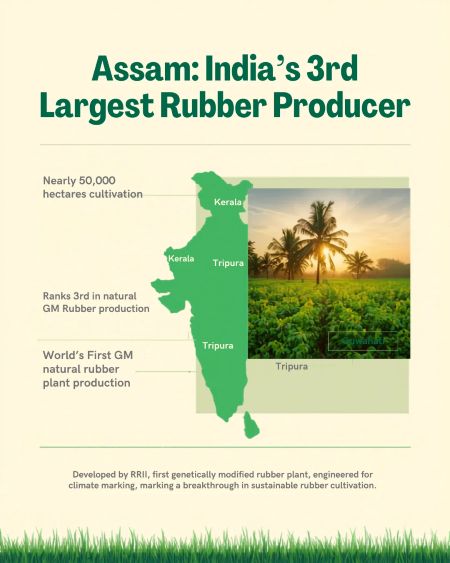
With nearly 50,000 hectares under cultivation and a growing share in the country's natural rubber output, Assam is emerging as a major player in India's rubber sector. Speaking at a press briefing in Guwahati, Rubber Board executive director M Vasanthagesan said that Assam currently ranks third in natural rubber production after Kerala and Tripura.
He said that the State has become a key contributor to the expansion of rubber cultivation in the Northeast, a region that now accounts for around 1.8 lakh hectares of rubber plantations. "The focus is not only on increasing the area under cultivation but also on improving productivity to meet the rising domestic demand for natural rubber", Vasanthagesan said.
He also highlighted the progress of the INROAD Project, a Rubber Board initiative funded by the Automotive Tyre Manufacturers Association (ATMA), which seeks to expand rubber plantations across the Northeast and West Bengal. Against a target of developing two lakh hectares between 2021 and 2026, plantations have already been established over 1.79 lakh hectares, benefiting more than 2.07 lakh growers.
Chaudhary said rubber is increasingly being recognized alongside tea as an important plantation crop with export potential. Improved market access through India's Free Trade Agreements and government backed export promotion initiatives could further boost prospects for the industry, she added.
She said that these agreements are enabling Indian businesses to access new international markets and strengthen the country's export competitiveness. Sectors such as agriculture, textiles, pharmaceuticals and plantation products are among the major beneficiaries of these trade agreements.
She also spoke on the theme "FTAs and New Opportunities with Special Focus on Plantation and Forest Products", highlighting the benefits of India's Free Trade Agreements and the emerging opportunities they present for exporters, producers and stakeholders in the plantation and forest products sectors.
Chaudhary further informed that India's total export value stood at $863bn in 2025-26 which is significantly higher than the $468 bn in 2014-15, growing at a compounded annual growth rate of 5.7 per cent. She highlighted how the transformation in digital infrastructure of trade with platforms such as Trade Connect, Trade Intelligence & Analytics (TIA) portal, a sturdy grievance redressal system and overall Ease of Doing Business initiatives have assisted traders and exporters in the country.