Natural rubber, tapped from trees as latex, is the world's most widely used bio-elastomer. Comprising long molecular chains that make it pliable and stretchy yet highly resistant to cracking and strain, natural rubber is foundational to countless products, including the heavy duty tires in trucks, buses, and airplanes.
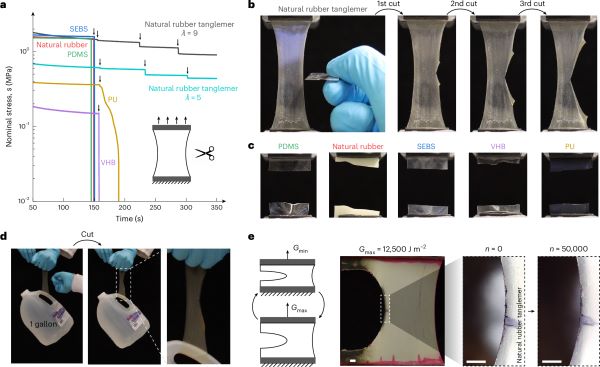
But to make rubber products that can withstand those demanding applications, large machines must mix in reinforcing particles, usually carbon black or silica, that chew up the rubber's long polymer chains and effectively sacrifice many of the natural material's most exceptional properties, from elasticity to cold resistance. The result is a tire that's sufficiently stiff, yet prone to wearing and cracking, which produces polluting dust as it wears and decreases its lifespan. It doesn't have to be this way, says a new Harvard study. A team from the lab of Zhigang Suo, the Allen E. and Marilyn M. Puckett Professor of Mechanics and Materials at the John A. Paulson School of Engineering and Applied Sciences (SEAS), along with Yakov Kutsovsky, Expert-in-Residence at Harvard's Office of Technology Development, has developed a simple new way to process natural rubber that preserves its unique long molecular chains while uniformly mixing in strength-endowing particles. The result is a composite material that is both unusually stiff and extraordinarily tough-properties that rarely go hand in hand in rubber products.
The work, published in Proceedings of the National Academy of Sciences, points to a future where more durable truck, bus and airplane tires can be made from tree-derived rubber, with potential to cut waste, reduce tire dust pollution, and open new avenues for high-performance elastomers in applications such as soft robotics. It also seeds an eventual pathway to upending the industry for synthetic rubber tires, which are used in passenger cars and derived from petroleum. "Waste can come in the form of these tire dust particles, and it can come in the form of just throwing tires away", said first author Matthew Wei Ming Tan, former Harvard postdoctoral researcher and now an assistant professor at Nanyang Technological University, Singapore. "We eventually want a circular economy that minimizes waste and cycles materials back into use. Extending tire lifespan is a key part of that-the longer each tire lasts, the fewer raw materials we need to extract and the less waste we generate in the first place". Until now, the challenge has been how to mix solid particles into natural rubber without tearing those long chains apart. In latex, natural rubber exists as tiny spheres-"like meatballs in water", as Tan describes it. Simply adding particles to that latex doesn't work: the particles stay in the water and fail to penetrate the rubber spheres. Dry-mixing, as used today, solves the mixing problem but at the cost of cutting those chains, known as chain scission.