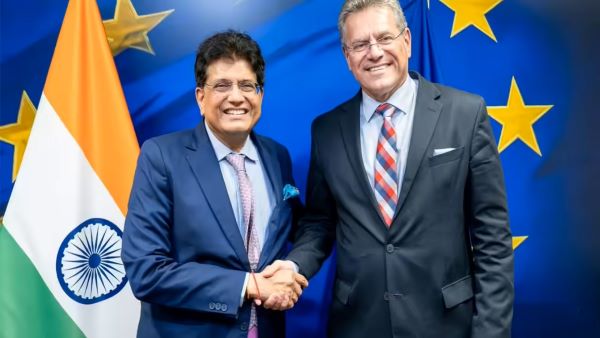
India and the European Union (EU) are in the final stages of negotiating a long-pending free trade agreement (FTA), which, once concluded, will become India's 19th trade pact and is expected to significantly boost exports to the 27-nation bloc.
Since 2014, India has finalized seven trade agreements, including with Mauritius, Australia, the UAE, Oman, the UK, the European Free Trade Association (EFTA) and New Zealand. The proposed India-EU FTA assumes added importance amid disruptions in global trade flows due to high US tariffs, with Indian exports facing duties of up to 50 per cent. The agreement is expected to help Indian exporters diversify markets and reduce dependence on China.
Under an FTA, tariffs are reduced or eliminated, regulations are aligned, and market access improves. The agreement is expected to benefit key sectors such as technology, pharmaceuticals, automobiles and textiles. Lower duties would make Indian exports from labour-intensive sectors, including garments, leather, pharmaceuticals, steel, petroleum products and electrical machinery more competitive in the EU.
The FTA is expected to substantially boost bilateral trade. India's goods trade with the EU stood at $136.53 billion in 2024-25, with exports of $75.85 billion and imports of $60.68 billion, making the bloc India's largest trading partner for goods. The EU accounts for about 17 per cent of India's total exports, while India absorbs around 9 per cent of the EU's overseas shipments. In 2023-24, India exported $76 billion in goods and $30 billion in services to the EU, while EU exports to India totaled $61.5 billion in goods and $23 billion in services. Key EU destinations for Indian exports include Germany, Spain, Belgium, Poland and the Netherlands.